Sterilisation vs Disinfection in a Salon
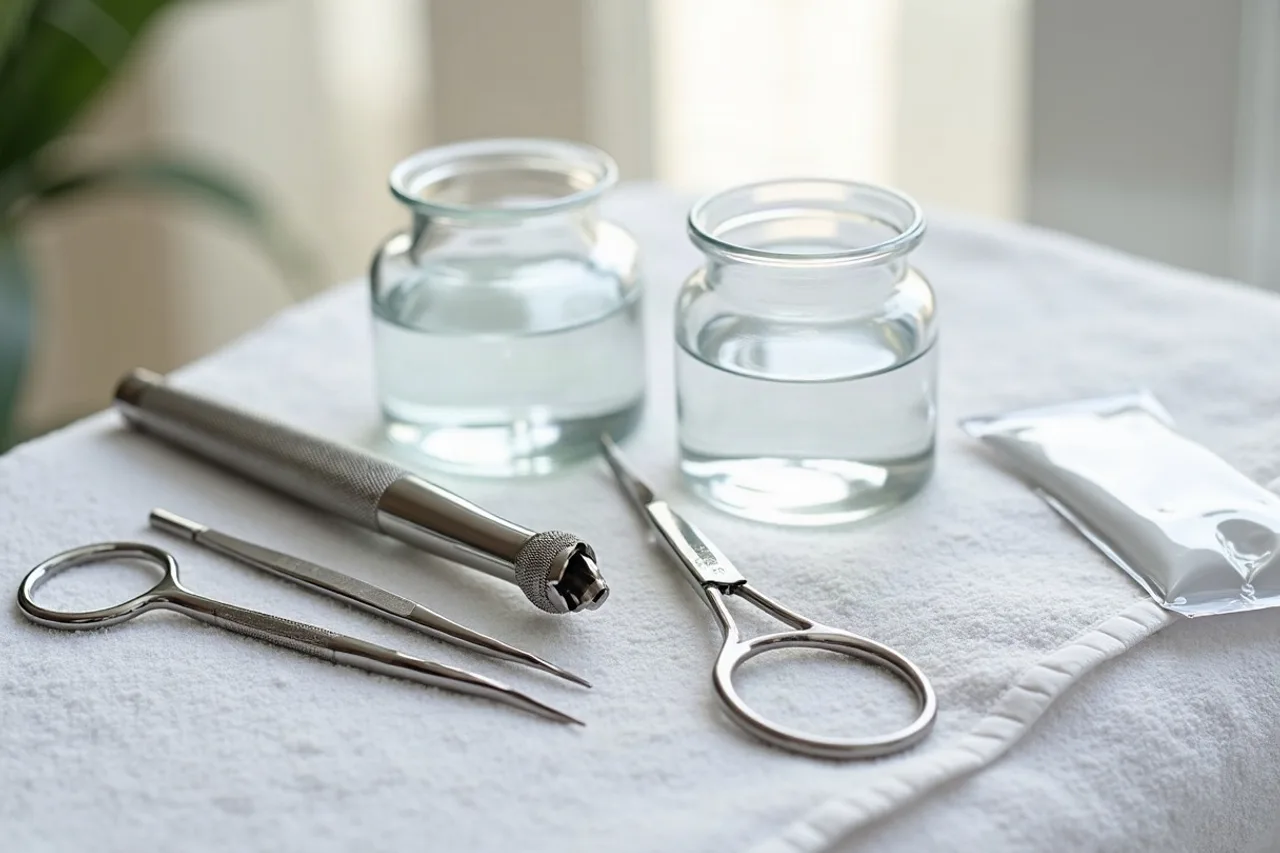
Sterilisation vs disinfection in a salon: GIS definitions, a table of nail, brow and lash tools, and the records worth keeping.
In short: sterilisation and disinfection are two different processes. Disinfection reduces the number of microorganisms to a level that does not endanger health. Sterilisation destroys the forms of biological pathogens that are able to multiply. The recommendations of the Chief Sanitary Inspector (GIS, May 2026) assign them to different tools: sterilisation applies to reusable tools that break the continuity of tissue, while disinfection is enough where a tool touches only intact skin. Below we set out what is what, which tools in a nail, brow and lash salon need which process, and what to record in your documentation.
Key points
- Disinfection and sterilisation are separate stages of decontamination. One does not replace the other.
- According to GIS, reusable tools that break the continuity of tissue go through pre-disinfection, washing and cleaning, proper disinfection and sterilisation.
- Tools that touch only intact skin: washing and cleaning, and disinfection.
- Washing is a condition for effective disinfection and sterilisation. Washing alone is not enough, and merely "dipping in a liquid" is not sterilisation.
- For each stage, state in the procedure who carries it out and where you record it.
Sterilisation vs disinfection: definitions
The glossary of the GIS recommendations gives short definitions on which you can base your procedure:
- Decontamination is a process that includes washing, disinfection and sterilisation, intended to reduce biological pathogens.
- Washing and cleaning is mainly the mechanical removal of dirt, dust and contamination.
- Disinfection is the reduction of microorganisms to a level that does not endanger human health. It can be thermal or chemical.
- Sterilisation is a process of destroying the forms of biological pathogens that are able to multiply.
In everyday language the difference sounds like this: after disinfection a tool is microbiologically cleaner, after sterilisation (and in undamaged packaging) it is sterile. That is why in the decontamination chain disinfection comes before sterilisation, not instead of it. For tools that cannot be sterilised, the recommendations allow high-level disinfection, meaning an agent that is bactericidal, tuberculocidal, virucidal, fungicidal and sporicidal.
Sterilisation vs disinfection: which tools need which process
GIS divides reusable tools by the risk of transmitting infection. The risk is high when a tool may break the continuity of the skin, does break it, or touches intact mucous membranes. The risk is low with contact with intact skin.
| Risk | Process according to the GIS recommendations |
|---|---|
| High (breaking or possibly breaking the continuity of the skin) | Pre-disinfection, washing and cleaning, proper disinfection, sterilisation |
| Low (intact skin) | Washing and cleaning, disinfection |
The annexes to the recommendations break this down into specific tools. For a nail, brow and lash salon it looks like this:
| Tool | What the recommendations say |
|---|---|
| Nail and cuticle nippers and scissors | Washing and cleaning, rinsing and drying, disinfection, sterilisation |
| Tweezers (lashes, brows) | Washing and cleaning, rinsing and drying, disinfection, sterilisation |
| Drill bits, burs, buffers, files | Single use is recommended. If reused: washing, disinfection, and sterilisation if contaminated with blood. Paper files single use only |
| Cuticle pusher | Wooden or made of porous material: single use only. Reusable: washing, disinfection, sterilisation |
| Soaking bowls, foot baths | Washing, disinfection after every client |
| Lash curlers, brow and lash brushes | Washing, immersion disinfection after every client |
| Toe separators, pumice, face sponges | Single-use products are recommended |
Note the drill bits. In the main part of the recommendations they are listed among the tools that are sterilised. In the manicure annex the recommendation reads differently: single use, and for repeated use sterilisation when blood contamination occurred. The document does not resolve this difference. The safe wording for your procedure is to sterilise reusable drill bits after every client, or to switch to single-use ones. Check the full list for your procedures in annexes 3 and 4 of the recommendations.
Disinfection and sterilisation in practice: the order of steps
The order is not optional. The GIS recommendations describe it like this:
- Pre-disinfection limits the number of microorganisms and stops contamination from drying on. Tools may be kept dry for up to 3 hours after use, then they must be decontaminated.
- Washing and cleaning with a cleaning agent and suitable brushes, under the surface of the solution, in room-temperature water. Hot water makes contamination stick and water that is too cold hardens fats. The recommendations stress that washing alone is not sufficient, especially for tools of complex construction. An ultrasonic cleaner is a safe method.
- Rinsing and drying under running water.
- Proper disinfection by immersion, following the agent manufacturer's instructions, with an agent that is at least bactericidal, virucidal and fungicidal.
- Packaging in sterilisation packaging after visual inspection for cleanliness and condition.
- Sterilisation, recommended with steam at overpressure in a steriliser meeting at least the PN-EN 13060 standard. The device is described in autoclave: what it is and how it works.
- Storage in a clean, dry place. Treat a pouch with damaged packaging as non-sterile.
The recommendations also allow one-step decontamination with a combined cleaning and disinfecting agent. They describe it right after low-risk tools, so do not treat it as a substitute for sterilisation. The layout of the station for this order, that is the flow from the dirty zone to the sterile one, is covered in the decontamination flow in a salon. A fuller treatment of disinfection for manicure tools is in the guide manicure tool disinfection.
The most common mistakes in salons
- Disinfection instead of sterilisation for cuticle nippers and scissors. The recommendations point to sterilisation for these tools.
- Skipped washing. Dirt blocks the action of both the agent and the steam. The order of washing, disinfection and sterilisation only makes sense as a whole.
- Contact time too short. Concentration and contact time are given by the agent's manufacturer. The label matters more here than habit.
- Old solution. If the manufacturer has not stated a usable life for the solution, the recommendations require changing it daily or after every use (for substances sensitive to organic contamination, e.g. chlorine, active oxygen).
- Unlabelled container. The container with the solution should show the name of the agent, the concentration, the date it was prepared and the details of the person who prepared it.
- Decontamination during a procedure. The recommendations say that decontamination work must not take place during services that break the continuity of tissue. You need separation in space or in time.
- An opened, unused pouch put back. Sterile material opened at the station but not used goes through full decontamination and new packaging.
What to record in your documentation
The Act requires procedures covering the rules for using equipment that is sterilised and the methods of disinfection and decontamination (Article 16(2)). The GIS recommendations add that it is worth keeping documentation that links the tools used on a client with decontamination processes. In practice you will need:
- a procedure describing each stage, consistent with the sanitary procedure template,
- a surface and tool disinfection plan with agents, concentrations and times, as in the article on the salon hygiene plan,
- cards for the agents used: name, concentration, time, date the solution was prepared,
- sterilisation cycle records, covered in the article on the sterilisation log in a salon,
- safety data sheets of the disinfecting agents, available to staff.
Records are evidence of your diligence. They do not guarantee the outcome of an inspection.
Frequently asked questions
Is disinfection enough instead of sterilisation?
For low-risk tools that touch only intact skin, the GIS recommendations provide for washing and disinfection. For tools that break or may break the continuity of the skin, they additionally provide for sterilisation. The exception is tools that cannot be sterilised: high-level disinfection is then permitted.
Does sterilisation replace disinfection?
No. In the recommendations, proper disinfection comes before sterilisation in the whole decontamination chain. First you remove contamination and reduce microorganisms, then you package and sterilise.
What should I disinfect tools with before sterilisation?
An agent that is at least bactericidal, virucidal and fungicidal, used according to the label: concentration, time, method of use. The recommendations do not name a specific brand and neither do we.
What about single-use tools?
Single-use tools are used once, on one client, and those that break the continuity of tissue are collected in rigid containers with single-closure lids. For some tools (drill bits, files, separators) the recommendations explicitly point to single use.
Can I outsource sterilisation and do disinfection myself?
Yes. The recommendations allow sterilisation by a specialised provider with a quality management system (ISO or GMP). You must hold documents of regular cooperation, and hand tools over in protected packaging, in tightly closed transport containers. Washing and disinfection before handover remain in your salon's procedure.
Legal status as of: 2 November 2026
Legal basis: Article 16 of the Act of 5 December 2008 on preventing and combating infections and infectious diseases in humans (consolidated text: Journal of Laws 2025, item 1675; we checked the amending acts published after this text: Journal of Laws 2026, items 26 and 791, neither changes Article 16); "Hygiene and sanitary recommendations and requirements of the Chief Sanitary Inspector for beauty services" (GIS, May 2026, chapters III-V, glossary, annexes 3 and 4, version from gov.pl). Not checked: labels and safety data sheets of specific products, standard PN-EN 13060 (paid), definitions in other legal acts, the Official Gazette (Monitor Polski) or draft regulations.
Last reviewed: 2 November 2026
Disinfection plan and tool disinfection card
The NailsReady Foundation package includes templates for a disinfection plan, a tool disinfection card and a sterilisation procedure. You enter your own agents, concentrations and times from the labels. Check the scope of documents on the package page.
See the Foundation package